

Self Propelled Concrete Mixer
 2026-07-06
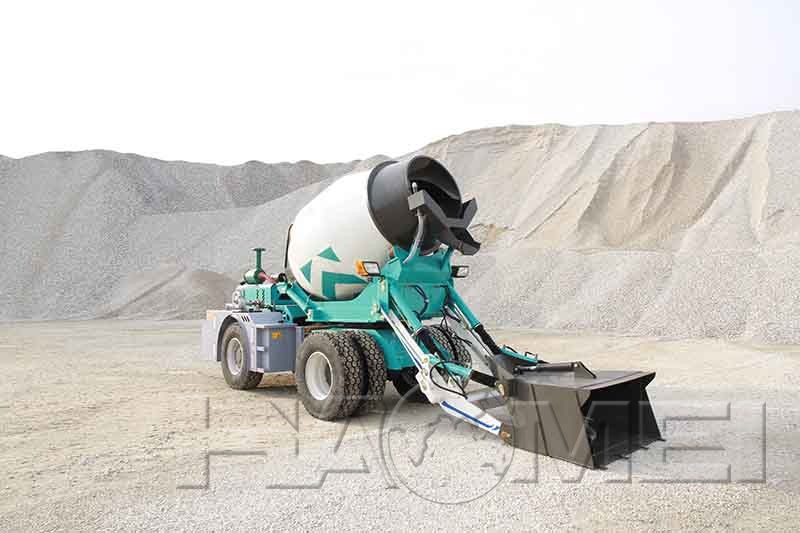
A self propelled concrete mixer combines a loader, weighing system, water tank, mixing drum, and mobile chassis in one machine. It solves a specific problem: making concrete close to the pour point when truck access, batching plant distance, or small-volume scheduling makes ready-mix supply inefficient.
Use it for rural roads, drainage works, farms, small bridges, foundations, utilities, and repair projects where daily concrete demand is frequent but not always predictable. Do not treat it as a full batching plant unless the job specification allows mobile mixing and the machine has calibrated aggregate, cement, and water measurement.
1. Match Capacity to Site Conditions
Start with output, not drum size. Nominal drum capacity is only useful after you check travel distance, loading time, discharge time, slump control, and access width.
A practical production estimate is:
Daily concrete volume = batch size x batches per hour x productive hours
For example, a 3.5 m3 class mixer completing 3 cycles per hour for 6 productive hours can place about 63 m3 per day. If the machine must travel far between aggregate stockpiles and the pour, output falls quickly.
For urban utility work, the HM3.5 Self Mixer class is often easier to route through tighter sites. For larger pavement, yard slab, and remote infrastructure work, a HM 5.5 Self Mixer class machine can reduce the number of cycles, provided the site can handle its turning radius and loaded axle weight.
| Selection factor | What to verify | Why it matters |
|---|---|---|
| Batch capacity | 1.2 to 6.5 m3 classes are common in the market | Oversizing raises fuel use and tire cost; undersizing delays pours |
| Drive system | 4x4 or 4x2, differential lock, gradeability | Wet soil and ramps require traction reserve |
| Weighing accuracy | Load cell calibration records and display units | Concrete strength depends on repeatable proportions |
| Water metering | Flow meter or tank scale | Too much water reduces compressive strength |
| Drum rotation | Mixing and discharge speed control | Affects uniformity and unloading time |
| Operator visibility | Camera, mirrors, loader view | Reduces collision and bucket loading errors |
| Service access | Filters, greasing points, drum rollers | Downtime is often caused by basic maintenance delays |
Avoid buying only by cubic meters. Two machines with the same nominal capacity may differ in loader breakout force, water tank size, hydraulic cooling, and weighing software.
2. Plan Cost, Utilization, and Payback
A self-propelled mixer is an investment in site autonomy. It pays when it replaces idle labor, remote ready-mix delivery charges, or multiple small mixer crews. It does not pay when concrete demand is rare, specifications require certified ready-mix delivery tickets, or the site has no trained operator.
Request written quotations in the same trade term, such as EXW, FOB, CIF, or DDP. Public price claims vary widely by country, emission standard, capacity, option package, shipping date, and exchange rate, so use supplier invoices and landed-cost quotes rather than informal online ranges.
| Cost item | How to compare it | Decision action |
|---|---|---|
| Purchase price | Same capacity, engine tier, weighing system, warranty | Reject quotes that omit major options |
| Freight and import cost | Incoterms 2020 basis, duty, port fees, inland trucking | Build a landed-cost sheet before approval |
| Fuel | Liters per hour under loading and mixing duty | Ask for field references, not idle consumption |
| Wear parts | Tires, blades, drum rollers, hydraulic hoses | Price a 12-month spare package |
| Calibration | Scale certification interval and local service access | Include it in annual maintenance |
| Operator cost | One trained operator versus separate loader and mixer crew | Calculate labor saved per m3 |
| Resale | Brand support, parts availability, hour meter records | Keep service logs from day one |
A simple payback method works well:
Calculate current concrete cost per m3, including delivery waiting time, rejected loads, labor, and small equipment.
Estimate mobile mixing cost per m3, including cement, aggregates, water, fuel, operator, maintenance, and finance.
Multiply the saving by realistic annual production, not the theoretical maximum.
Add downtime allowance. For fleet planning, 10% to 20% non-productive time is common on small sites due to relocation, cleaning, and material handling.
Test payback against low, normal, and high utilization scenarios.
Concrete quality needs discipline. ASTM C94/C94M covers ready-mixed concrete requirements, while many project specifications also refer to ACI practices or local standards such as EN 206 in Europe. If the contract requires plant-batched concrete, confirm approval before using mobile equipment. Keep batch records for cement bags or silo discharge, aggregate moisture adjustment, water dosage, admixture use, time of mixing, and discharge location.
3. Run It Safely and Track Fleet Data
Before operation, create a repeatable daily process. Mobile concrete production fails most often through poor stockpile control, water errors, untrained driving, and skipped cleaning.
Pre-start checklist:
Check engine oil, coolant, hydraulic oil, brake fluid, and tire pressure.
Inspect bucket pins, loader arms, drum rollers, chute lock, and hydraulic leaks.
Confirm water tank level and meter function.
Verify the weighing system is zeroed on level ground.
Test lights, horn, reverse alarm, camera, parking brake, and emergency stop.
Remove hardened concrete from the drum mouth and discharge chute.
Confirm cement storage is dry and aggregate stockpiles are separated by size.
Operating sequence:
Load aggregate according to the mix design, not by bucket habit.
Add cement with dust control and PPE.
Add measured water in stages to avoid overshooting slump.
Mix for the supplier-recommended drum revolutions or the project-specified time.
Discharge close to the placement area, then wash the chute and drum before buildup hardens.
Safety rules are not optional. In the United States, OSHA 29 CFR 1926.601(b)(4) addresses audible reverse alarms or observer control for vehicles with obstructed rear view, and 29 CFR 1926.602 covers material handling equipment requirements. In the European market, machinery must comply with applicable machinery safety legislation; Regulation (EU) 2023/1230 replaces the Machinery Directive after its transition period. Local road registration, lighting, braking, and axle-load rules also apply if the unit travels on public roads.
Digitalization is changing fleet decisions. Telematics, GPS geofencing, fuel monitoring, electronic batch logs, and maintenance alerts are increasingly requested by contractors managing multiple small sites. For a self propelled concrete mixer, useful data points include batches per day, fuel per m3, water added per batch, engine hours, drum hours, fault codes, and operator ID.
Rank machine offers with a weighted scorecard:
| Criterion | Suggested weight | Evidence to request |
|---|---|---|
| Concrete output fit | 25% | Site cycle calculation and demo video |
| Measurement control | 20% | Calibration certificate and batch log sample |
| Safety equipment | 15% | Compliance documents and inspection checklist |
| Service support | 20% | Parts list, response time, local technician access |
| Total ownership cost | 20% | Landed cost, warranty terms, wear-part prices |
Final purchase checks before signing:
Confirm engine emission compliance for your country or project.
Specify drum capacity, water tank, weighing system, camera, air-conditioning, and tire type in the contract.
Ask for operator training and maintenance training in writing.
Order filters, hoses, sensors, blades, seals, and tire repair items with the machine.
Require English manuals, electrical diagrams, hydraulic diagrams, and parts books.
Set acceptance tests for weighing accuracy, mixing function, braking, steering, and leakage before final payment.
Original Source: https://www.self-loading-mixer.com/a/self-propelled-concrete-mixer.html
Tags: self propelled concrete mixer | self loading concrete mixer | mobile concrete mixer
Send us a Message
Category
| HM1.2 Self Mixer |
| HM1.8 Self Mixer |
| HM2.0 Self Mixer |
| HM 2.6 Self Mixer |
| HM3.5 Self Mixer |
| HM4.0 Self Mixer |
| HM 5.5 Self Mixer |
| HM6.5 Self Mixer |
Relate Blogs
Relate Products
CONTACT US
| Haomei Self Loading Mixer Co.,Ltd |
| Tel/Whatsapp: +86-15978414719 |
| Email: feedom@haomei-machinery.com |
| Website: https://www.self-loading-mixer.com |
| Office Add: 1103, No.14 Outer Ring Road, CBD, Zhengzhou, China |


