

Self Loading Mixer Truck VS Small Concrete Plant VS Ready Mix Concrete
 2026-02-04
In construction, concrete supply is a core factor affecting project progress, quality, and cost. Whether it's rural road paving, minor municipal repairs, or county-level infrastructure projects, construction companies face a crucial choice: use self loading concrete mixer trucks, build a small-scale batching plant, or directly purchase ready-mixed concrete?
The Roles of These Three Options
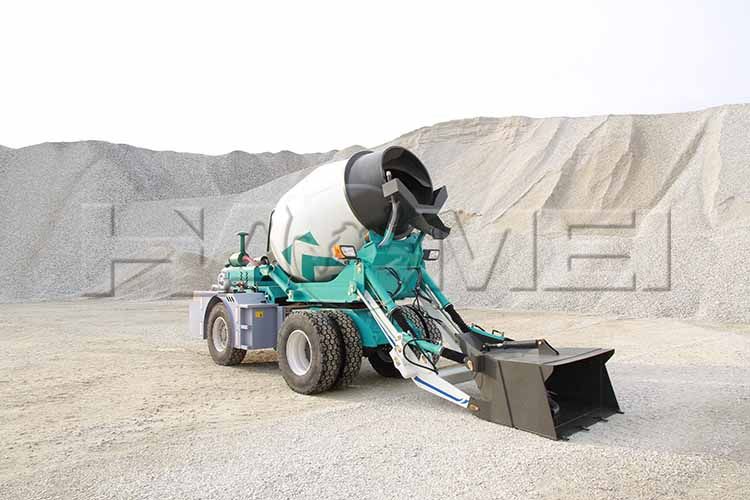
- Self-loading Concrete Mixer Trucks: Mobile equipment integrating loading, mixing, transportation, and discharging. They require no external loading equipment, allowing one person to independently complete the entire concrete production process, offering exceptional flexibility.
- Small-scale Batching Plants: Typically refer to models such as HZS25, HZS35, and HZS50 (theoretical hourly output of 25-50 cubic meters). They operate on a fixed site and require auxiliary equipment such as loaders and transport vehicles. Suitable for regional, continuous supply.
- Purchased Ready-mixed Concrete: Centrally produced by specialized commercial concrete plants and delivered to the construction site by concrete trucks. Construction companies do not need to invest in production equipment; they only need to bear the procurement and transportation costs.
Comparison of Applicable Radius
1. Self-loading Mixer Truck
The core advantage of the self-loading mixer truck is its "mobility." Its applicable radius is not determined by transportation distance, but by the dispersion of construction sites and terrain conditions. Because it can source materials and mix on-site, eliminating the need to travel to fixed stations, theoretically it can cover any construction site the vehicle can reach. It is particularly suitable for the following scenarios:
- Short-distance, scattered operations: Rural road hardening, farmland irrigation ditches, rural house construction, etc., with a service radius typically within 5-15 kilometers (exceeding this radius results in excessively long transportation times, affecting concrete workability);
- Complex terrain operations: Mountainous areas, remote areas, or narrow construction sites (minimum turning radius of only 4.7-6.2 meters), where ordinary mixer trucks struggle to pass, the self-loading mixer truck, with its four-wheel drive and small turning radius, can flexibly adapt;
- Emergency repair operations: Small emergency projects such as road damage and pipeline repairs, eliminating the need to wait for commercial concrete supply, allowing for rapid on-site mixing, and the radius can be flexibly adjusted.
2. Small-Scale Concrete Mixing Plants
The small concrete plant operates on a fixed site, relying on mixer trucks to transport concrete to the construction site. Their applicable radius is limited by both transportation time and cost:
- Core Service Radius: 10-20 kilometers. Within this range, transportation costs are lower (short round-trip time for mixer trucks, controllable fuel and labor costs), and the stability of concrete quality is guaranteed (avoiding premature setting due to long transportation times);
- Maximum Service Radius: 30 kilometers. Beyond this radius, it is necessary to consider increasing the number of mixer trucks or adjusting transportation routes; otherwise, transportation costs will skyrocket (e.g., increased fuel costs, vehicle depreciation costs), and the workability of the concrete is difficult to guarantee;
- Suitable Scenarios: Concentrated construction projects within a county (such as multiple rural residential clusters, small-scale municipal engineering projects), supporting precast component factories, or areas far from large commercial concrete plants, suitable for continuous batch supply (hourly output of 25-50 cubic meters).
3. Purchased Ready-Mixed Concrete
The applicable radius for purchased ready-mixed concrete is determined by the concrete plant's capacity, transportation distance, and initial setting time. There are clearly defined reasonable ranges within the industry:
- Optimal radius: 20-30 kilometers. Within this range, the concrete plant can quickly deploy vehicles, transportation costs (usually included in the concrete price) are low (approximately 17 RMB/cubic meter), and the time from production to pouring can be controlled within 1.5 hours, ensuring stable quality.
- Reasonable radius: 30-50 kilometers. Beyond 30 kilometers, the concrete plant will charge additional transportation fees (calculated by mileage), and more transport vehicles are needed to avoid delays. Suitable for large-scale projects in and around cities (such as real estate development and municipal main roads).
- Prohibited radius: Above 50 kilometers. Long-distance transportation can lead to excessive slump loss and premature setting, affecting project quality. Furthermore, transportation costs may exceed the material cost of the ready-mixed concrete itself, resulting in extremely low cost-effectiveness.
Cost Comparison
1. Self-loading Concrete Mixer Truck
Core Cost: One-time investment of US$28,000-112,000 per unit, no additional investment in site, infrastructure, etc.; unit operating cost of US$53.2-58.8/cubic meter (including materials, labor, and machinery costs); average annual hidden costs (depreciation + maintenance) of US$4,200-9,800.
Suitable Scenarios: Scattered operations in complex terrains with an annual demand of 500-5000 cubic meters; flexible and controllable after investment.
2. Small Concrete Mixing Plant
Core Cost: One-time investment of US$70,000-210,000 (including equipment, infrastructure, and auxiliary equipment, excluding fleet and land); unit operating cost of US$49.0-54.6/cubic meter; hidden costs (environmental protection + working capital + permits) of US$91,000-182,000.
Suitable Scenarios: Centralized operations in areas with an annual demand of over 5000 cubic meters; large-scale operation can amortize high investment costs.
3. Purchased Ready-Mixed Concrete
Core Costs: No one-time investment; unit procurement cost is $61.6-67.2 per cubic meter (including transportation, taxes, etc.), but hidden costs such as waiting time and quality control must be borne.
Suitable Scenarios: For projects with unstable annual demand (below 500 cubic meters) or short-term emergency pouring; saves time and effort with no equipment risks.
Original Source: https://www.self-loading-mixer.com/a/self-loading-mixer-truck-vs-small-concrete-plant-vs-ready-mix-concrete.html
Tags: self loading concrete mixer truck
Prev: What Makes a High-Efficiency Self Loading Concrete Mixer Truck
Send us a Message
Category
| HM1.2 Self Mixer |
| HM1.8 Self Mixer |
| HM2.0 Self Mixer |
| HM 2.6 Self Mixer |
| HM3.5 Self Mixer |
| HM4.0 Self Mixer |
| HM 5.5 Self Mixer |
| HM6.5 Self Mixer |
Relate Blogs
Relate Products
CONTACT US
| Haomei Self Loading Mixer Co.,Ltd |
| Tel/Whatsapp: +86-15978414719 |
| Email: feedom@haomei-machinery.com |
| Website: https://www.self-loading-mixer.com |
| Office Add: 1103, No.14 Outer Ring Road, CBD, Zhengzhou, China |


