

Self Loading Concrete Mixer Truck for Island Infrastructure
 2026-03-20
Remote from the mainland, with poor transportation, limited space, and constant sea wind and salt spray corrosion—infrastructure construction on islands has always been synonymous with extreme working conditions and high-difficulty construction. Traditional concrete mixing plants are large in size, have high transportation costs, and are difficult to relocate.
Long-distance pumping of concrete is prone to problems such as segregation and excessively rapid setting, seriously slowing down construction progress and affecting project quality. In such harsh environments, self loading concrete mixers, with their multi-functional, flexible, and efficient characteristics, have become a core and essential piece of equipment for island infrastructure construction, even to the point of being "indispensable."
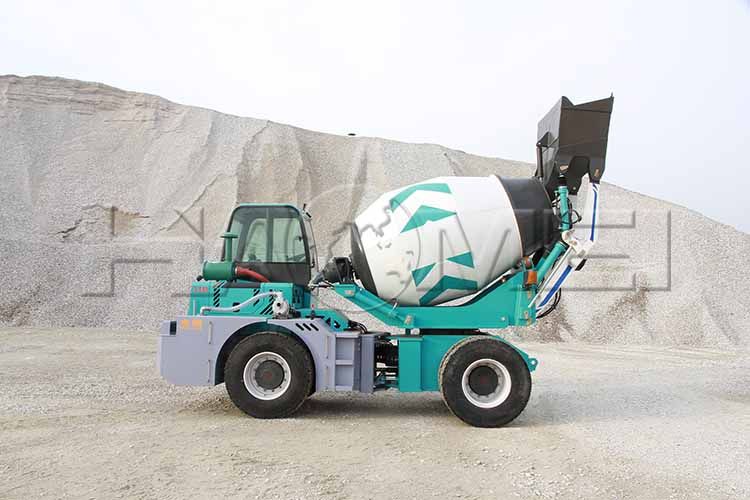
Why is self-loading transit mixer indispensable for island infrastructure construction?
The unique characteristics of island construction mean that ordinary construction machinery is difficult to adapt, while self-loading equipment perfectly solves many industry pain points. Its core irreplaceable nature is reflected in the following points:
- Eliminating site limitations, eliminating the need to build stationary batching plants: Island land area is limited, and most terrain is rugged. Building large fixed mixing plants not only requires a large area and is expensive, but also damages the island's ecosystem. Self-loading concrete mixer trucks integrate loading, mixing, transportation, and unloading functions, eliminating the need for additional facilities. They can mix concrete wherever they are needed, completely saving on construction costs and time.
- Solves transportation challenges and ensures concrete quality: Precast concrete from the mainland, transported by long-distance sea freight and short-distance transshipment, is prone to problems such as segregation, initial setting, and slump loss. Salt spray environments accelerate material degradation. Self-loading mobile concrete mixers mixes and pours concrete on-site, precisely controlling mix proportions. It can also add anti-corrosion and anti-permeability admixtures as needed, adapting to the high-salt, high-humidity, and high-freeze-thaw conditions of island environments, thus enhancing project durability.
- Mobile and flexible, suitable for decentralized construction: Infrastructure projects on islands are often scattered, with multiple simultaneous construction sites, from revetments to roads, from buildings to pipelines, being commonplace. Self-loading concrete mixer trucks have a small turning radius and strong off-road capabilities, allowing them to navigate narrow construction sites and sloping roads, flexibly changing locations and significantly improving construction efficiency.
- Cost Reduction and Efficiency Improvement, Streamlining Manpower and Resources: Traditional construction requires multiple machines, including loaders, mixing plants, and transport vehicles, resulting in high labor costs, fuel consumption, and material losses. Self-loading equipment can be operated by a single person, automating feeding and mixing, reducing material transfer links, and lowering overall construction costs by more than 30%, while also shortening the construction period.
- Adaptability to Island Ecology, Environmental Compliance: Most islands are ecologically sensitive areas, where fixed mixing plants generate significant dust and have difficult-to-manage wastewater discharge. Self loading concrete machine offers strong airtightness, eliminating dust pollution during mixing and facilitating waste cleanup, thus meeting the construction requirements for island ecological protection.
Core Application Scenarios
Island infrastructure covers multiple fields such as people's livelihood, transportation, coastal defense, and ecology. Self-loading mixer trucks, with their strong adaptability, cover the vast majority of concrete pouring projects. Common application scenarios include:
1. Port and Coastal Defense Projects
This is a crucial aspect of island infrastructure, including wharf breast walls, revetment wave walls, breakwaters, and pier foundations. These types of projects have extremely high requirements for concrete's impermeability, freeze-thaw resistance, and chloride ion corrosion resistance. Self-loading equipment mixes special concrete on-site, precisely unloading and pouring it to ensure structural density, resist sea wave and salt spray erosion, and solidify the foundation for island defense and shipping.
2. Island Transportation Network Projects
Projects such as internal island roads, ring roads, bridges, culverts, and helipad hardening are mostly long and scattered. Self-loading mixer trucks can mix and pour along the route, eliminating the need for frequent material transfers. They are suitable for construction on rugged roads, quickly completing roadbed and pavement concrete work, and opening up the island's transportation network.
3. Public Welfare and Supporting Infrastructure
Small-scale infrastructure projects on islands, such as residential buildings, office buildings, warehouses, water and electricity supply networks, sewage treatment facilities, and photovoltaic pile foundations, are flexible in scale but limited in space. Self-loading equipment does not require large-scale sites and can precisely complete sporadic pouring, component prefabrication, and pipeline backfilling and reinforcement, ensuring the implementation of public welfare supporting facilities on the island.
4. Emergency Repair and Maintenance Projects
Islands are highly susceptible to typhoons and storm surges, making their infrastructure vulnerable to damage. Self-loading concrete mixers offer rapid deployment and start-up, enabling quick on-site mixing and repair of revetments, roads, buildings, and other facilities, thus enhancing the island's disaster prevention and mitigation capabilities.
Recommended Models for Island Infrastructure Construction
Island construction requires a balance of mobility, mixing capacity, and salt spray resistance. Considering practicality for various working conditions, the 3.5 cubic meter and 4.0 cubic meter models are highly recommended, supplemented by smaller auxiliary mixers, covering all construction needs. The parameters and suitable scenarios for the mainstream models are as follows:
3.5 cubic self loading mixer
The 3.5 m3 self loading concrete mixer is the preferred standard for island construction. With a stable tank volume of 3500L, it is equipped with a 90-105KW high-power engine and a full-time four-wheel drive heavy-duty chassis, balancing mobility and load-bearing capacity. It is agile in turning and capable of climbing slopes, perfectly suited to the rugged and confined environment of island construction sites.
The tank body is made of a special wear-resistant and corrosion-resistant material, capable of withstanding sea wind and salt spray erosion. Combined with an intelligent electronically controlled mixing system, it ensures high concrete mixing uniformity and precise control of the mix proportions.
Whether it's paving main roads around the island, constructing medium-sized wharves, reinforcing revetments, or building large-scale residential housing and photovoltaic power generation systems, this model can efficiently handle the task, making it an all-rounder that balances efficiency and flexibility.
4.0 cubic self loading mixer machine
This 4.0 m3 self loading concrete mixer truck is designed for large-scale infrastructure projects on islands. The tank volume has been upgraded to 4000L, using a turbocharged high-power engine and a heavy-duty off-road chassis with stronger load-bearing capacity, maximizing stability during continuous construction. The large-capacity hopper design reduces the frequency of material loading, and the overall mixing efficiency is 20% higher than conventional models, making it particularly suitable for batch pouring and continuous operation scenarios.
The entire machine comes standard with anti-corrosion sealing kits, providing comprehensive protection against high-salt and high-humidity environments. It is mainly used in large-scale coastal defense projects, breakwater pouring, wharf main structure construction, and other centralized key infrastructure projects, meeting the needs of large-scale, high-intensity construction.
Original Source: https://www.self-loading-mixer.com/a/self-loading-concrete-mixer-truck-for-island-infrastructure.html
Tags: self loading concrete mixer
Send us a Message
Category
| HM1.2 Self Mixer |
| HM1.8 Self Mixer |
| HM2.0 Self Mixer |
| HM 2.6 Self Mixer |
| HM3.5 Self Mixer |
| HM4.0 Self Mixer |
| HM 5.5 Self Mixer |
| HM6.5 Self Mixer |
Relate Blogs
Relate Products
CONTACT US
| Haomei Self Loading Mixer Co.,Ltd |
| Tel/Whatsapp: +86-15978414719 |
| Email: feedom@haomei-machinery.com |
| Website: https://www.self-loading-mixer.com |
| Office Add: 1103, No.14 Outer Ring Road, CBD, Zhengzhou, China |


