

Rough Terrain Self Loading Concrete Mixer
 2026-06-01
Receently, most discussions around rough terrain self loading concrete mixer selection have focused less on basic definitions and more on real jobsite doubts: traction, daily output, capacity choice, operating cost, and what to inspect before payment. The questions below reflect common wording seen in search suggestions, Q&A threads, and construction equipment discussions.
| Recent Question People Ask | What They Are Really Trying To Decide |
|---|---|
| Can a self loading concrete mixer work on muddy and steep sites? | Whether the machine can replace manual mixing or delivered concrete in remote areas. |
| What capacity should I choose for rough terrain work? | Whether a compact unit or a 3.5 m3 to 6.5 m3 model fits the project rhythm. |
| How much concrete can it produce per day? | Whether one machine can support slabs, roads, foundations, or farm projects. |
| Is it cheaper than a batching plant and transit mixer? | Whether flexible on-site batching reduces labor, waiting time, and waste. |
| What should I inspect before buying one? | Whether the equipment will be reliable after months of hard use. |
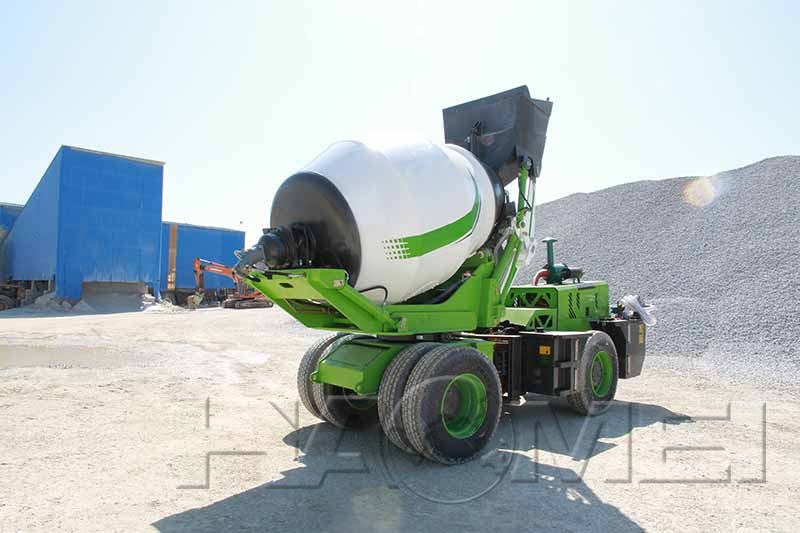
1. Can a rough terrain self loading concrete mixer really work on muddy, steep, or unpaved roads?
Yes, if the machine is designed as a true off-road mixer rather than a small urban mixer with larger tires. For rough terrain, check 4x4 drive, articulated steering, ground clearance, tire tread, drum stability, and gradeability. A quality rough terrain self loading concrete mixer should climb moderate slopes while loaded, but operators must still control drum fill, speed, and turning angle.
Mud is usually harder than slope because it reduces traction and increases rolling resistance. In wet clay, a full drum can make the machine dig into the ground. For this reason, many experienced operators reduce batch volume by 10% to 20% when the route is soft. On rocky tracks, ground clearance and chassis protection become more important than engine power alone.
| Terrain Condition | Practical Check Before Work |
|---|---|
| Muddy road | Use deep tread tires and avoid full-speed steering. |
| Steep access road | Confirm loaded gradeability, not empty gradeability only. |
| Loose gravel | Keep the drum balanced and avoid sudden braking. |
| Narrow rural road | Check turning radius and cab visibility. |
| Uneven foundation area | Confirm frame strength and axle oscillation. |
2. What size should I choose: 1.2 m3, 2.6 m3, 3.5 m3, 5.5 m3, or 6.5 m3?
Capacity should match the pour size, access road, available water source, and operator skill. Many new equipment purchasers assume a larger drum is always better, but oversizing can create problems on weak roads, small village lanes, or tight residential sites.
A compact machine is useful for sidewalks, farm buildings, drainage channels, and small foundations. A mid-range machine, especially around 3.5 m3, is often selected for rural roads, house foundations, and small commercial work because it balances output and maneuverability. Larger models suit wider sites, repeated pours, and projects where aggregate, cement, and water are already organized near the mixing area.
For general model comparison, a Self Loading Mixer range can help you compare drum capacity, engine power, and site suitability. For many contractors working on medium-scale rural jobs, the HM3.5 Self Mixer class is a practical reference point.
| Capacity Range | Suitable Work Type | Main Advantage | Watch Point |
|---|---|---|---|
| 1.2 m3 to 1.8 m3 | Small repair, farm work, narrow sites | Easy access | Lower daily output |
| 2.0 m3 to 2.6 m3 | Villas, paths, drainage | Balanced size | Needs steady material supply |
| 3.5 m3 to 4.0 m3 | Rural roads, foundations, small buildings | Strong versatility | Needs trained operator |
| 5.5 m3 to 6.5 m3 | Repeated pours, larger open sites | Higher productivity | Requires wider turning space |
3. How much concrete can one machine produce per day?
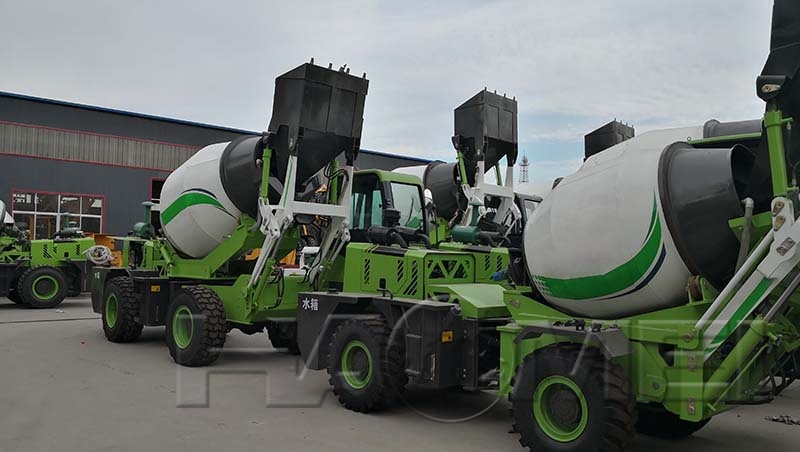
Daily output depends on batch size, loading time, mixing time, travel distance, discharge speed, and cleaning time. A self loading concrete mixer does not produce at factory batching plant speed, but it saves time by loading, mixing, transporting, and discharging with one machine.
A realistic cycle may take 15 to 25 minutes when aggregates and cement are close. If the machine must travel far between the material pile and pouring point, the cycle can increase to 30 minutes or longer. A 3.5 m3 machine completing two cycles per hour for eight working hours may theoretically handle around 56 m3, but real production is often lower after breaks, site movement, water adjustment, and cleaning.
| Model Class | Realistic Daily Output Range | Best Working Condition |
|---|---|---|
| Small compact class | 10 m3 to 25 m3 | Short transport distance and simple pours. |
| Medium 3.5 m3 class | 30 m3 to 55 m3 | Organized materials and continuous work. |
| Large 5.5 m3 to 6.5 m3 class | 50 m3 to 85 m3 | Open site, fast loading, planned discharge points. |
The most common mistake is calculating output only from drum capacity. Site organization matters more. If cement bags are far away, the loader bucket is waiting for aggregate, or water supply is unstable, even a large rough terrain self loading concrete mixer will lose production time.
4. Is a self loading mixer cheaper than a batching plant plus transit mixer?
It can be cheaper for remote, scattered, or medium-volume projects. A batching plant works well when concrete demand is high and continuous. A transit mixer fleet works well where roads are good and ready-mix supply is nearby. A rough terrain self loading concrete mixer becomes attractive when concrete is needed in smaller batches at multiple points or where ready-mix delivery is unreliable.
The cost comparison should include labor, fuel, waiting time, rejected concrete, road access, and rental of extra machines. With a self loading mixer, one operator can complete loading, weighing by bucket system, mixing, transport, and discharge. This reduces coordination work. It also lets the site produce concrete when needed instead of waiting for a truck.
However, it is not the right choice for every project. If a site needs hundreds of cubic meters every day with strict laboratory-controlled mix designs, a batching plant may still be better. If a project needs flexible daily output, fast relocation, and concrete in difficult access areas, self loading equipment often makes stronger financial sense.
5. What should I inspect before paying for a rough terrain self loading concrete mixer?
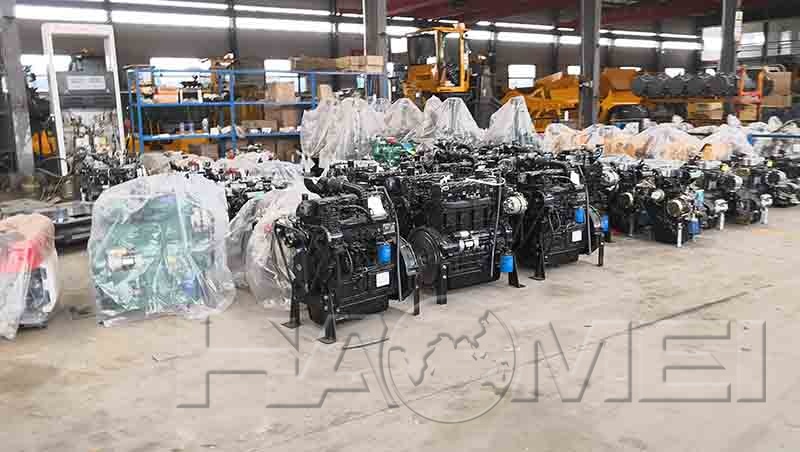
Start with the chassis, hydraulic system, drum, engine, transmission, tires, braking system, weighing system, and after-sales support. Ask for operating videos on rough ground, not only flat factory-floor videos. If possible, test steering, braking, loading bucket movement, drum rotation, water pump function, and discharge control.
| Inspection Item | What To Confirm |
|---|---|
| Engine and transmission | Smooth starting, stable power, no abnormal smoke. |
| Hydraulic system | No leakage, slow response, or shaking during bucket lifting. |
| Drum and blades | Strong rotation, clean welds, wear-resistant mixing blades. |
| Weighing system | Repeatable measurements for aggregate, cement, and water. |
| Tires and axles | Proper off-road tread, strong axle housing, good ground clearance. |
| Spare parts | Availability of filters, hydraulic hoses, sensors, seals, and wearing parts. |
| Operator comfort | Clear view, safe steps, understandable control layout. |
Also ask about training. A rough terrain self loading concrete mixer is simple compared with a full batching plant, but it still needs correct loading order, water control, cleaning habits, and safe driving practice. Poor operation can cause low concrete strength, drum buildup, tire damage, and unnecessary hydraulic wear.
Original Source: https://www.self-loading-mixer.com/a/rough-terrain-self-loading-concrete-mixer.html
Tags: rough terrain self loading concrete mixer | self loading concrete mixer | off-road concrete mixer
Send us a Message
Category
| HM1.2 Self Mixer |
| HM1.8 Self Mixer |
| HM2.0 Self Mixer |
| HM 2.6 Self Mixer |
| HM3.5 Self Mixer |
| HM4.0 Self Mixer |
| HM 5.5 Self Mixer |
| HM6.5 Self Mixer |
Relate Blogs
Relate Products
CONTACT US
| Haomei Self Loading Mixer Co.,Ltd |
| Tel/Whatsapp: +86-15978414719 |
| Email: feedom@haomei-machinery.com |
| Website: https://www.self-loading-mixer.com |
| Office Add: 1103, No.14 Outer Ring Road, CBD, Zhengzhou, China |


