

Self Loading Concrete Mixer
 2026-02-27
Potential owners often start with the same few questions when comparing a self loading concrete mixer to ready mix deliveries or a standard mixer plus loader. Below are 5 high interest questions that have been trending across Google and social Q&A threads recently, with practical answers focused on real jobsite outcomes.
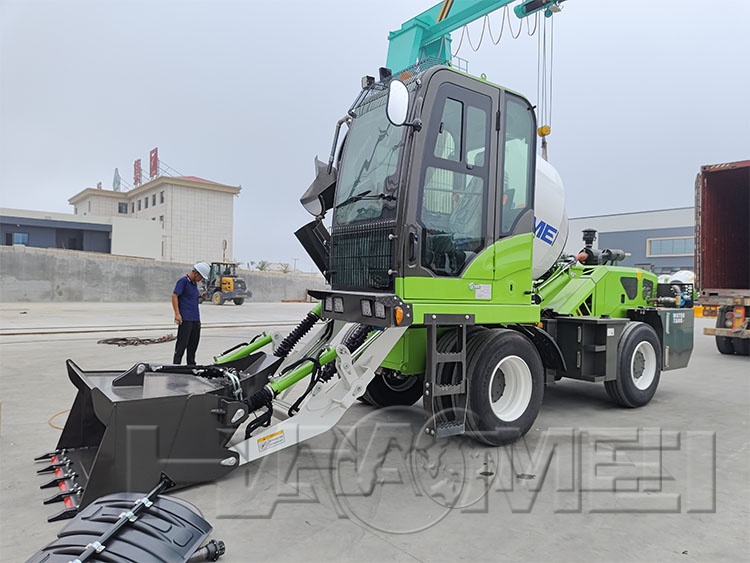
1) How much does a self loading concrete mixer cost in 2026, and what changes the price most?
Pricing is usually driven less by the drum and more by the full powertrain and hydraulics package. In most markets, the biggest price swings come from:
Capacity class: 1.2 to 2.0 m3 units cost less upfront, while 3.5 to 6.5 m3 machines rise quickly because axles, chassis, and hydraulic cooling scale up.
Engine and emissions tier: Higher tier engines often add cost but can reduce downtime risk in regulated areas.
4WD and steering configuration: Crab steering, articulated steering, and stronger driveline options increase cost and also change service complexity.
Weigh batching and automation: Load cells, water metering, and batch printouts increase accuracy, but they are not always standard.
After sales and spares availability: A lower purchase price can be offset by longer lead times for pumps, valves, or seals.
If you are comparing similar sizes, ask vendors to break out the quote into engine, hydraulic pump group, axle group, and batching system. That makes it easier to compare two machines that look similar in photos.
2) What is the real output per hour of a self loading concrete mixer, not the theoretical capacity?
Rated drum capacity is not the same as hourly production. Real output depends on the cycle time for loading aggregates, adding cement, water dosing, mixing, and driving to pour locations.
A practical way to estimate production is:
Hourly output ≈ effective batch size × cycles per hour
Effective batch size is typically 70 to 85 percent of nominal drum capacity if you want consistent slump and avoid spillage on rough ground.
| Mixer class (nominal) | Typical effective batch | Typical cycle time | Realistic output per hour |
|---|---|---|---|
| 1.2 to 1.8 m3 | 0.9 to 1.4 m3 | 18 to 28 min | 2 to 4.5 m3 per hour |
| 2.0 to 2.6 m3 | 1.5 to 2.1 m3 | 16 to 25 min | 3.5 to 7 m3 per hour |
| 3.5 to 4.0 m3 | 2.6 to 3.2 m3 | 15 to 22 min | 7 to 12 m3 per hour |
| 5.5 to 6.5 m3 | 4.0 to 5.0 m3 | 14 to 20 min | 12 to 20 m3 per hour |
Two tips that often improve output more than buying a larger mixer:
Stage aggregate piles so the bucket travel distance is short and flat.
Use calibrated water metering so you do not waste time adjusting slump every batch.
If you are evaluating models, you can compare sizes like the HM3.5 Self Mixer versus a smaller unit based on your target cubic meters per shift rather than nominal drum volume.
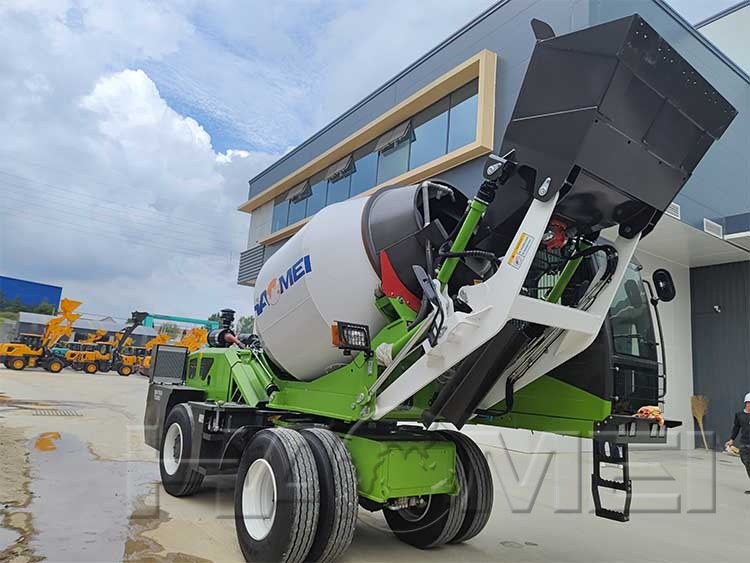
3) Is a self loading concrete mixer cheaper than ordering ready mix for small projects?
It can be, but only when your project pattern matches the machine.
Self loading mixers tend to win on cost when:
Your sites are remote or have poor access for transit mixers.
You pour frequently in small to medium batches, where short loads and waiting time inflate ready mix cost.
You can source aggregates, cement, and water locally at stable prices.
Ready mix often wins when:
You need strict quality documentation, lab tested mix designs, or high volume pours with continuous supply.
You have limited space for stockpiling aggregates.
Your labor or operator availability is uncertain.
A quick ROI check many contractors use is to compare:
Delivered ready mix cost per m3 at your site.
Your estimated self produced cost per m3 including cement, aggregates, fuel, operator, wear parts, and maintenance allowance.
If the gap is only small, ready mix may still be the better option because it reduces management burden. If the gap is large and you pour weekly, the machine often pays back faster.
4) How much diesel does a self loading concrete mixer use per hour, and what affects fuel burn most?
Fuel consumption varies widely because the machine does two energy heavy tasks: loading with hydraulics and traveling with a loaded drum. In typical mixed duty, many users report a range roughly 4 to 10 liters per hour, with bigger 4WD units trending higher.
The biggest drivers of fuel burn are:
Haul distance and slope: Long climbs with a full drum increase consumption quickly.
Tire choice and inflation: Underinflated tires on rough sites raise rolling resistance.
Hydraulic setup: Pumps running hot or relief valves set incorrectly waste power.
Operator habits: High RPM during idle, harsh acceleration, and unnecessary drum speed add up.
If fuel cost is a major concern, ask whether the model has a well sized oil cooler and a proven pump brand, and whether the vendor offers training on batching and driving cycles. Also consider selecting a capacity that matches your average pour size, because consistently running half loads is inefficient.
5) What maintenance issues should I expect, and how do I prevent job stopping breakdowns?
Most downtime problems are not mysterious, they are predictable wear points. The most common areas to watch are:
Hydraulic hoses and fittings: Vibration and rubbing cause leaks. Add hose guards and check routing weekly.
Water system: Blocked filters, stuck solenoids, or inaccurate flow meters lead to inconsistent slump. Flush the system daily if water has sediment.
Drum and mixing blades: Abrasion is normal. Track blade thickness and replace before mixing quality drops.
Brake and axle service: These machines carry heavy loads on uneven ground. Keep to a strict grease and inspection schedule.
Electrical connectors and sensors: Batch systems depend on stable signals. Use dielectric grease and protect connectors from washdown spray.
A practical checklist that reduces surprises is:
| Interval | What to do | Why it matters |
|---|---|---|
| Every shift | Check engine oil, coolant, hydraulic oil level, visible leaks, tire condition | Prevent heat and low oil failures |
| Daily | Clean radiator and oil cooler fins, flush water filter | Avoid overheating and dosing issues |
| Weekly | Grease pins, check drum ring gear area, inspect hoses for rubbing | Reduce wear and hose bursts |
| Monthly | Check brake performance, axle oil, batch calibration | Keeps travel safety and mix consistency |
If you are looking for a machine class often used for municipal work, small commercial slabs, and rural road maintenance, a mid size option such as the Self Loading Mixer category is commonly chosen because it balances maneuverability with daily output.
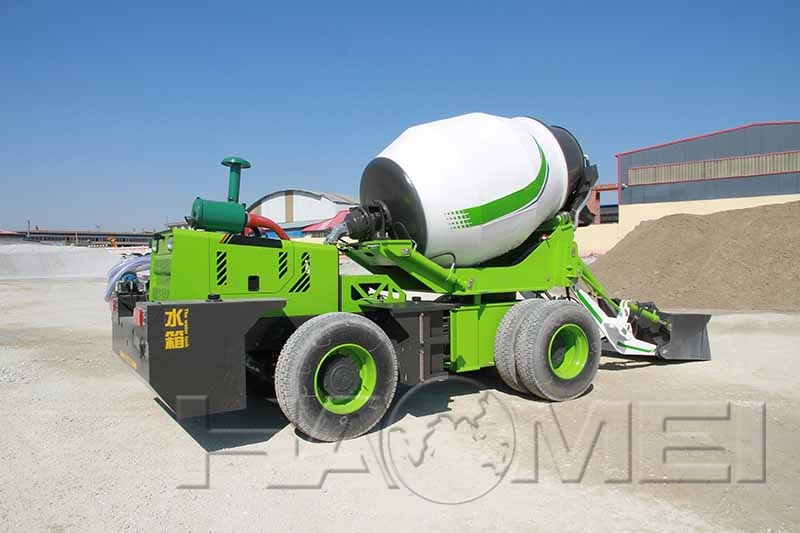
Quick comparison questions to ask before you commit
These questions help you match the machine to your sites and avoid overpaying for features you will not use.
What is the effective batch size at your target slump, and can it be demonstrated with your materials.
Can the water dosing be calibrated and locked to prevent operator guesswork.
What is the turning radius and steering mode, and will it fit your tightest site.
What are the lead times for hydraulic pumps, brake parts, and drum seals in your region.
Is there a simple method to clean the drum and chute without excessive water use.
Original Source: https://www.self-loading-mixer.com/a/self-loading-concrete-mixer.html
Tags: self loading concrete mixer | self loading mixer | concrete mixer truck
Prev: Self Loading Transit Mixer
Next: Self Loading Concrete Mixer Truck for Fast On Site Mixing
Send us a Message
Category
| HM1.2 Self Mixer |
| HM1.8 Self Mixer |
| HM2.0 Self Mixer |
| HM 2.6 Self Mixer |
| HM3.5 Self Mixer |
| HM4.0 Self Mixer |
| HM 5.5 Self Mixer |
| HM6.5 Self Mixer |
Relate Blogs
Relate Products
CONTACT US
| Haomei Self Loading Mixer Co.,Ltd |
| Tel/Whatsapp: +86-15978414719 |
| Email: feedom@haomei-machinery.com |
| Website: https://www.self-loading-mixer.com |
| Office Add: 1103, No.14 Outer Ring Road, CBD, Zhengzhou, China |


